
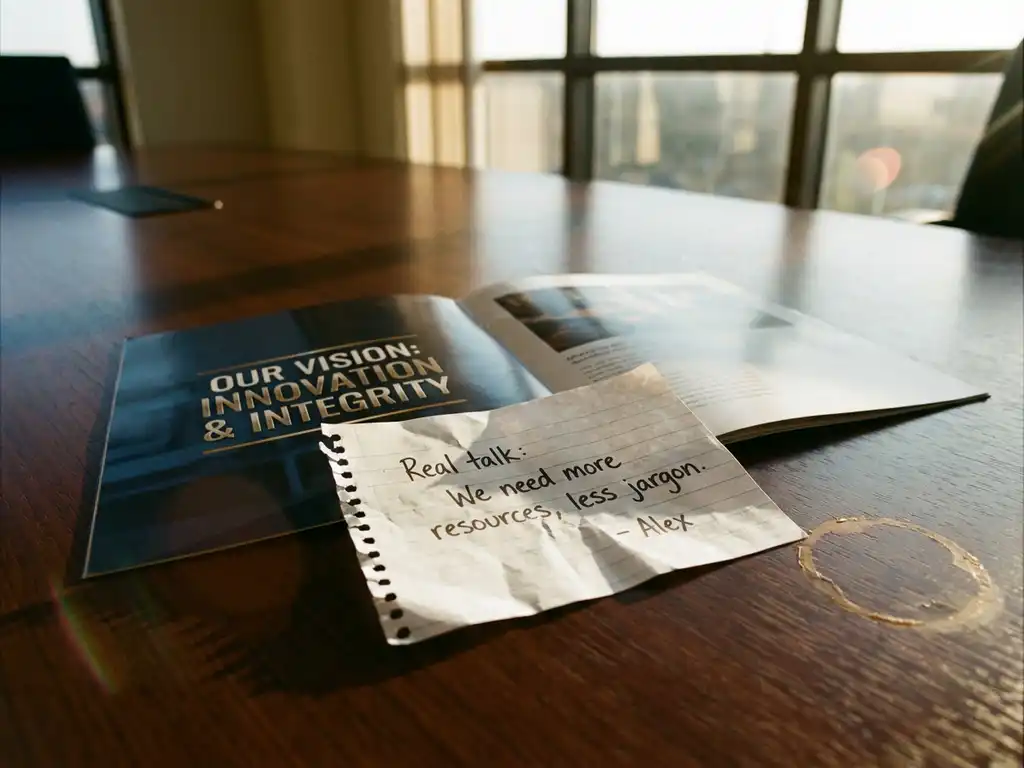
Many Dutch companies proudly display their purpose statements on glossy websites and in annual reports, yet employees remain disengaged and stakeholders feel overlooked. The harsh reality is that most corporate purpose initiatives serve marketing departments better than they serve genuine business transformation. For transitie-gedreven CEOs leading middelgrote bedrijven, distinguishing between authentic purpose and expensive marketing has become crucial to sustainable growth.
This article examines why traditional purpose statements fail, explores what separates genuine purpose from superficial campaigns, and provides a practical framework for integrating authentic purpose into every business decision. You’ll discover how conscious businesses achieve employee engagement of up to 90%, compared with Europe’s average of just 13%, and learn a proven methodology for developing purpose that drives measurable results.
Why most corporate purpose statements fail to inspire action
The fundamental problem with most corporate purpose statements lies in their disconnect from operational reality. Companies spend considerable resources crafting beautiful mission statements that sound impressive but fail to influence daily decisions or stakeholder relationships. Purpose-washing has become as prevalent as greenwashing: organisations claim conscious practices while prioritising profit extraction above all else.
Traditional purpose development suffers from three critical flaws. Vague language dominates these statements, using generic terms like “excellence” or “innovation” that could apply to any organisation. Leadership teams often develop these purposes in isolation, without meaningful stakeholder input, creating statements that feel imposed rather than inspired. Most damaging is the operational disconnect: purpose remains confined to marketing materials while business decisions continue to be driven purely by financial metrics.
Research reveals that purpose-linked brands grew by 175%, compared with 70% for companies with low purpose correlation, over twelve years. Yet many organisations fail to capture this growth because their purpose statements serve marketing campaigns rather than genuine transformation. The result is cynicism from employees who recognise the gap between stated values and lived experience.
What separates authentic purpose from expensive marketing campaigns
Authentic purpose proves itself through measurable stakeholder impact rather than polished communications. Genuine purpose-driven businesses integrate their higher purpose into every operational decision, creating alignment between stated values and daily practices. This integration becomes visible through specific indicators that distinguish authentic purpose from superficial marketing efforts.
Conscious businesses show consistent patterns across stakeholder relationships. Employee engagement reaches exceptional levels because purpose provides meaningful context for work beyond paycheques. Supplier relationships become long-term partnerships focused on mutual value creation rather than cost extraction. Customer interactions prioritise genuine service over manipulation, building trust through transparency and authenticity.
The measurement approach differs fundamentally between authentic and marketing-driven purpose. Marketing-led purpose tracks brand awareness and perception metrics. Authentic purpose measures stakeholder value creation, environmental impact reduction, and social contribution alongside financial performance. Companies with genuine purpose often discover unexpected positive side effects—what conscious business practitioners call “the magic factor”—where purposeful actions create beneficial outcomes beyond the original intentions.
How conscious businesses integrate purpose into every stakeholder decision
Practical purpose integration requires systematic embedding across all business processes and stakeholder interactions. Stakeholder inclusion becomes the operating framework, ensuring decisions consider impacts on employees, suppliers, customers, shareholders, society, and the environment simultaneously. This holistic approach transforms how organisations approach hiring, product development, supplier relationships, and community engagement.
Conscious leadership plays a crucial role in this integration. Leaders operating at higher levels of consciousness demonstrate emotional intelligence and systems thinking, enabling them to navigate the dynamic tensions between stakeholder needs. They recognise that a business is only as strong as its weakest stakeholder, making stakeholder success a strategic priority rather than a compliance requirement.
The business model itself evolves to support purpose integration. Traditional product-focused approaches shift toward service-oriented models that align incentives with stakeholder value. For example, companies move from selling products to providing solutions, ensuring quality and longevity benefit both the business and customers. This alignment creates positive feedback loops: purpose achievement drives employee engagement, which improves service quality, increases customer loyalty, enhances financial performance, and provides greater investment capacity for purpose realisation.
The proven framework for developing purpose that drives results
Developing authentic corporate purpose requires a structured methodology that ensures stakeholder consultation, measurable impact, and continuous refinement. The Conscious Business model provides this framework through five interconnected pillars: Higher Purpose, Conscious Leadership, Stakeholder Inclusion, Business Model Innovation, and Culture & Organisation Development.
The development process begins with an honest assessment of current consciousness levels across all organisational dimensions. Our CB Scan provides this baseline measurement, helping companies understand their starting point and identify specific development opportunities. This 15-minute assessment reveals how consciously your organisation operates and creates a personalised roadmap for transformation.
Implementation follows a progressive path: companies can begin immediately by committing to stakeholder value creation while developing deeper capabilities over time. Level A focuses on discovering authentic purpose and beginning leadership development. Level B builds momentum through leadership team engagement and deeper stakeholder relationships. Level C achieves advanced integration, where purpose fully guides strategy and decision-making processes.
The framework addresses common obstacles, including gaps in leadership consciousness, ingrained thinking patterns, and economic pressures that tempt organisations to abandon their principles during challenging periods. Success requires authentic commitment that cannot be faked, a systemic approach addressing all five pillars, and a long-term orientation that recognises benefits accumulate over time rather than appearing immediately.
Conscious businesses consistently outperform traditional approaches across multiple dimensions. Companies meeting conscious criteria outperformed the S&P 500 by a factor of fourteen over fifteen years, demonstrating that authentic purpose drives superior financial results alongside stakeholder value creation. For transitie-gedreven leaders, the question is not whether to develop authentic purpose, but how quickly and smoothly your organisation can make this transformation while maintaining competitive advantage and stakeholder trust. Start your journey by taking our Conscious Business assessment to discover where your organisation stands today.