
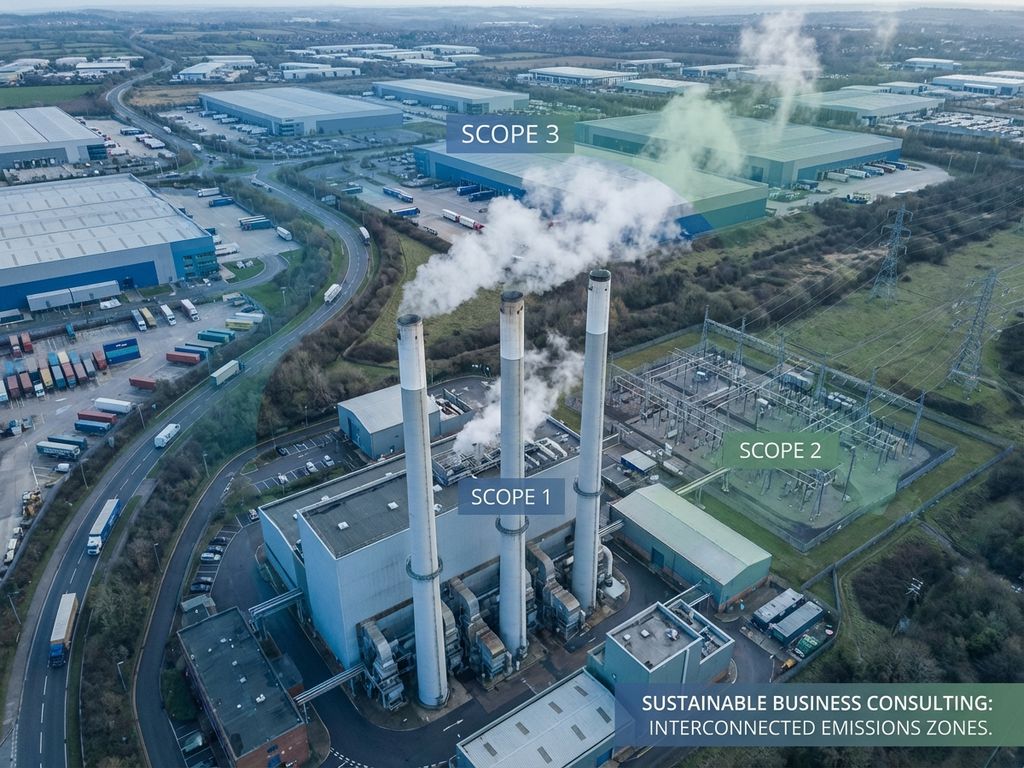
Scope 1, 2, and 3 emissions represent the three categories of greenhouse gas emissions that companies track to understand their complete carbon footprint. Scope 1 covers direct emissions from company-owned sources, Scope 2 includes indirect emissions from purchased energy, and Scope 3 encompasses all other indirect emissions throughout the value chain. Understanding these distinctions helps businesses develop comprehensive climate strategies and meet regulatory requirements.
What exactly are Scope 1, 2, and 3 emissions?
The three emission scopes provide a framework for categorizing all greenhouse gas emissions based on where they occur and who controls them. This classification system, developed by the Greenhouse Gas Protocol, ensures companies account for their complete environmental impact rather than just the most obvious sources.
Scope 1 emissions are direct emissions from sources you own or control. These include fuel combustion in company vehicles, heating systems in your buildings, and any industrial processes at your facilities. If your business operates delivery trucks, those exhaust emissions count as Scope 1. Manufacturing companies often have significant Scope 1 emissions from production equipment and on-site energy generation.
Scope 2 emissions come from the electricity, heating, cooling, and steam you purchase for your operations. Even though you do not directly burn fossil fuels, the power plant generating your electricity might. Your monthly electricity bill represents Scope 2 emissions because you are responsible for that energy demand.
Scope 3 emissions include everything else in your value chain that you do not directly control. This covers employee commuting, business travel, supplier activities, product transportation, and what happens to your products after customers use them. These often represent the largest portion of a company’s total emissions but are the hardest to measure and influence.
Why do companies need to track different emission scopes?
Companies track emission scopes because regulations increasingly require comprehensive climate reporting, investors demand transparency about environmental risks, and customers expect sustainable business practices. The Corporate Sustainability Reporting Directive (CSRD) in Europe mandates detailed emission reporting across all three scopes for many companies.
Regulatory compliance drives much of this tracking. The CSRD requires large companies and listed SMEs to report their environmental impact, including detailed greenhouse gas emissions data. Companies must demonstrate that they understand and manage climate-related risks across their entire value chain, not just their immediate operations.
Investors use emission data to assess long-term business viability and climate-related financial risks. They want to understand how well companies are positioned for a low-carbon economy. Complete emission tracking shows investors that management takes climate risks seriously and has systems in place to manage them effectively.
Business benefits extend beyond compliance. Understanding your complete carbon footprint helps identify cost-saving opportunities through energy efficiency and waste reduction. Many companies discover that measuring emissions leads to operational improvements that reduce both environmental impact and expenses.
Customer and stakeholder expectations also play a role. B2B customers often require suppliers to report emissions as part of their own Scope 3 calculations. Employees, particularly younger workers, increasingly want to work for environmentally responsible companies. Tracking and reducing emissions becomes part of attracting and retaining talent.
How do you actually measure Scope 1, 2, and 3 emissions?
Measuring emissions involves collecting activity data, applying emission factors, and calculating your carbon footprint using established methodologies. The Greenhouse Gas Protocol provides the standard framework, while various tools and software platforms help automate calculations and ensure accuracy.
For Scope 1 emissions, you collect data on fuel consumption from company vehicles, heating systems, and any industrial processes. This means tracking litres of petrol, cubic metres of natural gas, or kilowatt-hours from on-site generators. You then multiply this activity data by emission factors that convert fuel usage into CO2-equivalent emissions.
Scope 2 calculations use your electricity bills and energy consumption data. You can choose between location-based or market-based methods. Location-based uses the average emission factor for your electricity grid, while market-based accounts for specific renewable energy purchases or green electricity contracts you might have.
Scope 3 measurement proves more complex because you need data from suppliers, customers, and other value chain partners. You might use spend-based methods (estimating emissions based on money spent with suppliers), activity-based methods (collecting specific data from partners), or hybrid approaches combining both. Many companies start with spend-based calculations and gradually improve data quality over time.
Software tools help manage this complexity. Platforms range from simple spreadsheet templates to comprehensive carbon management systems that integrate with accounting software and supply chain databases. The choice depends on your company size, data complexity, and reporting requirements.
What is the biggest challenge companies face with Scope 3 emissions?
The biggest challenge with Scope 3 emissions is data availability and quality, as companies must rely on information from suppliers and partners who may not track their own emissions systematically. This creates gaps in measurement accuracy and makes it difficult to set realistic reduction targets or track progress effectively.
Supply chain coordination presents the most significant hurdle. Your Scope 3 emissions depend on data from potentially hundreds or thousands of suppliers, many of whom may not measure their own emissions or may use different calculation methods. Small suppliers often lack the resources to provide detailed emission data, while larger ones might be reluctant to share commercially sensitive information.
Data quality varies enormously across different Scope 3 categories. Business travel and employee commuting are relatively straightforward to track, but understanding the emissions from raw material extraction or end-of-life product disposal requires extensive value chain collaboration. Many companies rely on industry averages or spend-based estimates that provide limited accuracy.
Methodological complexity adds another layer of difficulty. Scope 3 includes 15 different categories, from purchased goods and services to investments and franchises. Each category requires different calculation approaches and data sources. Companies must decide which categories are material to their business and develop appropriate measurement strategies.
The scale of Scope 3 emissions can be overwhelming. For many companies, Scope 3 represents 70–90% of their total carbon footprint. This means the majority of their climate impact occurs outside their direct control, making reduction strategies more complex and requiring extensive stakeholder engagement to achieve meaningful progress.
Resource constraints limit many companies’ ability to tackle Scope 3 comprehensively. Collecting accurate data requires significant time investment and may require new systems, staff training, or external consultancy support. Smaller companies particularly struggle to balance Scope 3 measurement with other business priorities and limited sustainability budgets.
Understanding emission scopes provides the foundation for effective climate action and regulatory compliance. Companies that invest time in comprehensive measurement create competitive advantages through improved operational efficiency and stakeholder trust. At Conscious Business, we help organizations integrate emission tracking into their broader sustainable business strategies, connecting environmental responsibility with long-term value creation for all stakeholders.