
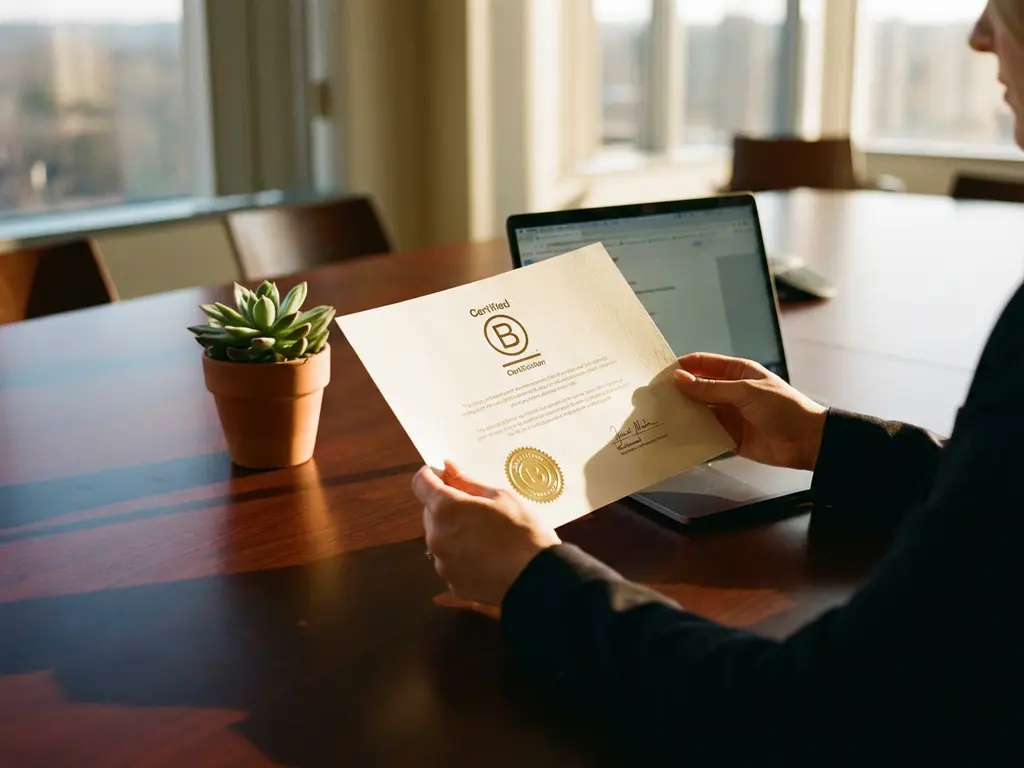
B Corp certification is a comprehensive third-party verification that evaluates companies on their social and environmental performance, accountability, and transparency. Unlike traditional business certifications that focus on single aspects, B Corp certification examines your entire business impact across five key areas: governance, workers, community, environment, and customers. This holistic approach helps sustainable business leaders demonstrate their commitment to balancing profit with purpose while meeting rigorous standards for ethical operations.
What exactly is B Corp certification and how does it work?
B Corp certification is a rigorous assessment process managed by the nonprofit B Lab that measures how your company’s operations and business model impact workers, customers, suppliers, the community, and the environment. Companies must score at least 80 points out of 200 on the B Impact Assessment, meet legal accountability requirements, and pay annual certification fees based on company revenue.
The certification process works through three main components. You complete the comprehensive B Impact Assessment, which examines your business practices across governance, workers, community, environment, and customers. B Lab then verifies your responses through documentation review and may conduct site visits for larger companies. Finally, you must amend your legal governing documents to include stakeholder governance provisions, ensuring your commitment to considering all stakeholders in decision-making.
What makes a company eligible starts with meeting minimum performance standards across all impact areas. You need demonstrated practices that benefit workers, such as fair compensation and professional development opportunities. Your community impact might include local sourcing, charitable giving, or job creation in underserved areas. Environmental considerations cover everything from resource efficiency to sustainable supply chains.
The certification operates on a three-year cycle. You maintain your status through annual impact reporting and must recertify every three years by retaking the B Impact Assessment. This ensures continuous improvement and prevents companies from becoming complacent about their sustainable business practices.
What are the main requirements to become a certified B Corporation?
The main requirements centre around three pillars: achieving a minimum score of 80 points on the B Impact Assessment, meeting legal accountability standards, and maintaining transparency through public reporting. The B Impact Assessment evaluates 200+ questions across governance, workers, community, environment, and customers, requiring documented evidence for your responses.
Legal accountability requirements vary by jurisdiction but typically involve amending your company’s articles of incorporation or operating agreement. These amendments must include provisions requiring directors to consider the impact of their decisions on all stakeholders, not just shareholders. Some regions allow benefit corporation status, while others require specific language about stakeholder governance.
Transparency obligations include making your B Impact Assessment score publicly available and submitting annual impact reports. You must also pay certification fees ranging from £500 for companies with under £150,000 annual revenue to £50,000+ for large corporations. These fees support B Lab’s operations and the ongoing development of impact measurement tools.
Documentation requirements are extensive. You need policies covering areas like worker benefits, environmental practices, community engagement, and governance structures. Financial records, employee handbooks, supplier agreements, and evidence of community involvement all play roles in the verification process. The more comprehensive your documentation, the smoother your certification journey.
Why do companies choose to pursue B Corp certification?
Companies pursue B Corp certification primarily for brand differentiation and access to a growing market of conscious consumers and investors. The certification signals authentic commitment to social and environmental responsibility, helping businesses stand out in crowded markets while attracting customers who prioritise values-aligned purchasing decisions.
Talent attraction represents another significant benefit. Research consistently shows that employees, particularly younger generations, prefer working for companies with clear social and environmental missions. B Corp certification helps recruit top talent who want meaningful work and provides existing employees with pride in their organisation’s verified impact.
Access to impact investment opportunities opens new funding channels. Many investors now specifically seek B Corp certified companies for their portfolios, viewing the certification as evidence of sustainable business practices and long-term thinking. This can lead to better financing terms and partnerships with like-minded organisations.
The certification process itself drives operational improvements. The B Impact Assessment highlights areas for enhancement across all business functions, providing a roadmap for continuous improvement. Many companies discover cost savings through environmental initiatives and improved employee retention through better workplace practices.
Network effects provide ongoing value through the global B Corp community. Certified companies gain access to peer learning opportunities, collaborative partnerships, and collective advocacy efforts. This community support helps businesses navigate challenges and identify new opportunities for impact and growth.
How long does the B Corp certification process actually take?
The B Corp certification process typically takes 6–12 months from initial application to final certification, though timelines vary significantly based on company size, complexity, and level of preparation. Well-prepared smaller companies may complete certification in 4–6 months, while large corporations often require 12–18 months due to additional verification requirements.
The assessment phase usually takes 2–4 months, depending on how quickly you can complete the B Impact Assessment and gather supporting documentation. Companies often underestimate the time needed to collect evidence for their responses, particularly around worker benefits, environmental data, and community impact metrics.
Verification steps add 2–6 months to the timeline. B Lab reviews your assessment responses and supporting documents, may request additional information, and conducts site visits for companies with over £100 million in revenue. The verification team checks approximately 10% of your assessment responses in detail, requiring comprehensive documentation.
Completion of legal requirements varies by jurisdiction and company structure. Simple amendments to articles of incorporation might take 2–4 weeks, while complex corporate restructuring could require several months. Some companies choose to work with legal counsel familiar with B Corp requirements to expedite this process.
Factors that speed up certification include thorough preparation before starting, having organised documentation systems, and dedicating sufficient internal resources to the process. Delays often result from incomplete documentation, unclear policies, or needing to implement new practices to meet minimum requirements. Companies serious about certification benefit from conducting informal assessments and addressing gaps before beginning the formal process.
What’s the difference between B Corp certification and other sustainability certifications?
B Corp certification differs from other sustainability certifications by examining your entire business model rather than focusing on specific products, processes, or environmental metrics. While ISO 14001 covers environmental management and Fair Trade addresses supply chain ethics, B Corp certification evaluates how your complete operations impact all stakeholders.
The holistic measurement approach sets B Corp apart. Instead of single-issue certifications, the B Impact Assessment covers governance, workers, community, environment, and customers simultaneously. This comprehensive view ensures companies cannot excel in one area while neglecting others, promoting balanced sustainable business practices across all operations.
Legal accountability requirements distinguish B Corp from voluntary certifications. Companies must amend their governing documents to legally consider stakeholder interests, creating binding obligations beyond marketing commitments. This legal framework provides stronger assurance of long-term commitment compared to certifications based solely on current practices.
The recertification model ensures continuous improvement rather than one-time compliance. While some certifications focus on maintaining standards, B Corp requires demonstrating enhanced impact every three years. This dynamic approach encourages innovation and prevents stagnation in sustainability efforts.
Community and network benefits exceed most other certifications. B Corp creates connections between certified companies for collaboration, learning, and advocacy. This peer-to-peer support system helps businesses improve their practices and amplify their collective impact in ways that product-specific or process-focused certifications typically cannot match.
The transparency requirements also surpass many alternatives. B Corp companies must publicly share their impact scores and submit annual reports, creating accountability that goes beyond internal compliance or third-party audits. This openness builds trust with stakeholders and encourages honest assessment of both strengths and areas for improvement.
Understanding B Corp certification helps you evaluate whether this comprehensive approach aligns with your sustainability goals. The certification demands significant commitment but provides a framework for building a truly sustainable business that benefits all stakeholders. At Conscious Business, we support organisations exploring various paths toward conscious operations, including understanding how certifications like B Corp fit within broader transformation strategies.