
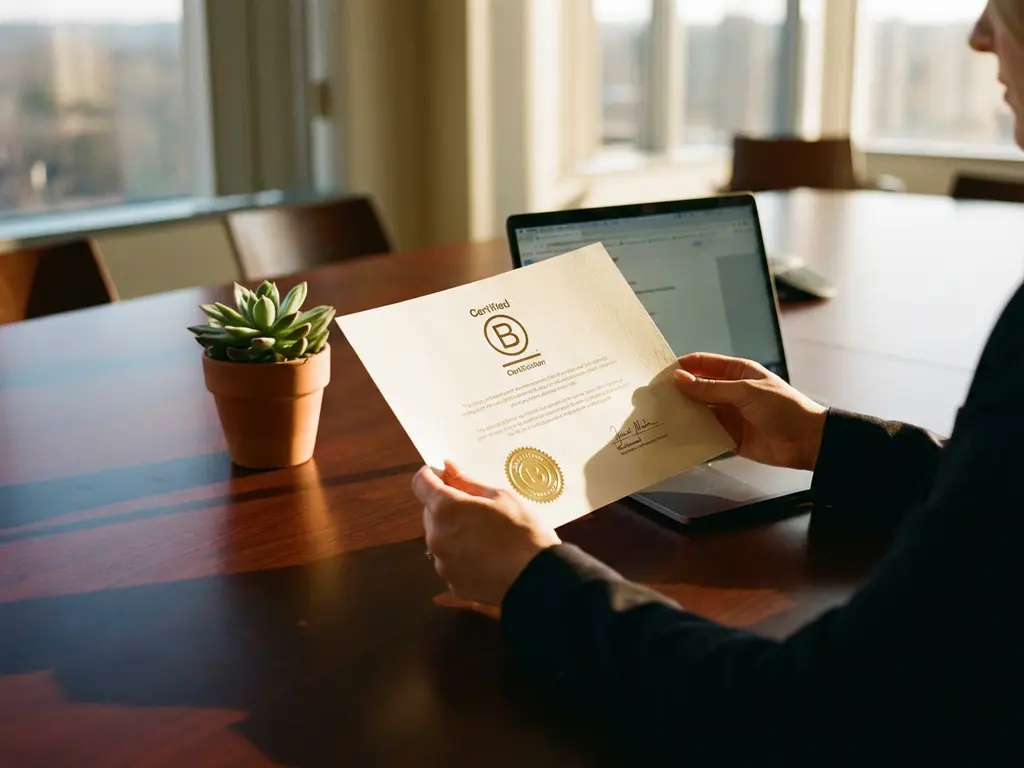
B Corp certification is a comprehensive third-party verification that evaluates companies on their social and environmental performance, accountability, and transparency. Rather than focusing on a single aspect, it examines your entire business across five key areas: governance, workers, community, environment, and customers. This holistic approach helps sustainable business leaders demonstrate their commitment to balancing profit with purpose.
What is B Corp certification and how does it work?
Managed by the nonprofit B Lab, B Corp certification measures how your operations and business model impact workers, customers, suppliers, the community, and the environment. To become certified, companies must:
- Score at least 80 out of 200 points on the B Impact Assessment
- Meet legal accountability requirements by amending governing documents to include stakeholder governance provisions
- Maintain transparency by making their impact score publicly available and submitting annual reports
- Pay annual certification fees, ranging from £500 for smaller companies to £50,000+ for large corporations
Certification follows a three-year cycle. You maintain your status through annual impact reporting and must recertify every three years, ensuring continuous improvement rather than one-time compliance.
What sets B Corp apart from other sustainability certifications?
Unlike certifications such as ISO 14001 or Fair Trade — which focus on specific processes or supply chain ethics — B Corp evaluates your complete business model. Companies cannot excel in one area while neglecting others. The legal accountability requirement also distinguishes it: governing documents must be formally amended, creating binding obligations that go beyond marketing commitments.
Transparency requirements are equally rigorous. B Corp companies must publicly share their impact scores and submit annual reports, building genuine trust with stakeholders.
Why pursue B Corp certification?
Companies choose B Corp certification for several practical reasons:
- Brand differentiation: the certification signals authentic commitment to social and environmental responsibility in crowded markets
- Talent attraction: employees, particularly younger generations, prefer working for companies with verified social and environmental missions
- Investment access: many impact investors specifically seek B Corp certified companies, which can lead to better financing terms
- Operational improvement: the B Impact Assessment highlights areas for enhancement across all business functions, often uncovering cost savings
- Community and network: certified companies gain access to peer learning, collaborative partnerships, and collective advocacy
How long does the process take?
The B Corp certification process typically takes 6–12 months, though timelines vary by company size and preparation level. Well-prepared smaller companies may complete it in 4–6 months; large corporations often need 12–18 months.
Key phases include:
- Assessment: 2–4 months to complete the B Impact Assessment and gather documentation
- Verification: 2–6 months for B Lab to review responses, request additional information, and conduct site visits where required
- Legal amendments: 2–4 weeks for straightforward changes, longer for complex structures
Thorough preparation before starting — organising documentation and addressing gaps early — significantly speeds up the process.
Understanding B Corp certification helps you evaluate whether this comprehensive approach aligns with your sustainability goals. At Conscious Business, we support organisations exploring various paths toward conscious operations, including how certifications like B Corp fit within broader transformation strategies.
Related Articles
- How do you reduce employee turnover through organizational culture?
- From Generic Mission Statement to Genuine Higher Purpose: How to Make the Leap
- What One Company Did Instead of Laying People Off During a Crisis — And Why It Worked
- What is the role of AI in conscious leadership training?
- What baseline data do you need before improving sustainability?