
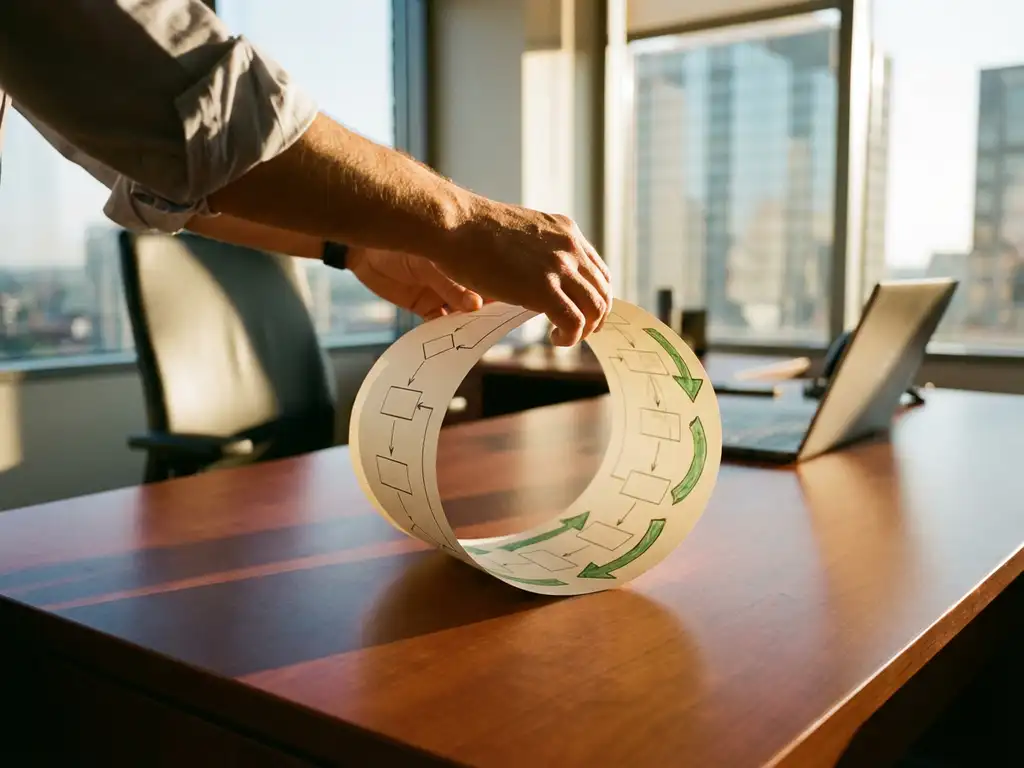
The business landscape is shifting beneath our feet. Traditional linear models that served companies well for decades are now creating vulnerabilities that threaten long-term survival. Resource scarcity, regulatory pressure, and evolving stakeholder expectations are forcing MKB companies to rethink their fundamental approach to value creation.
The circular economy represents more than an environmental trend; it’s a complete reimagining of how sustainable business transformation can create competitive advantage. Companies embracing circular economy business models are discovering that they’re not just future-proofing their operations but also unlocking new revenue streams and opportunities for stakeholder value creation.
We’ll explore why linear models are failing, what makes circular approaches resilient, and how Dutch MKB companies are successfully navigating this transformation using conscious business principles.
Why linear business models are failing in today’s economy
The traditional take-make-waste approach is buckling under mounting pressures that didn’t exist when these models were designed. Resource scarcity has fundamentally shifted the focus from capital to talent, innovation, materials, and planetary health. This change undermines the basic assumptions on which linear business models depend.
Regulatory frameworks like the CSRD (Corporate Sustainability Reporting Directive), in effect since January 2024, require companies with €40M in revenue, 250+ employees, or a €20M balance sheet to report on human, environmental, and societal impacts. This isn’t just compliance paperwork; it forces transparency around resource flows and waste streams that linear models struggle to justify.
Consumer expectations have evolved dramatically. Research shows that purpose-driven brands grew 175%, compared with 70% for brands with low purpose correlation, over 12 years. Younger generations, in particular, demand different values around work, meaning, and impact. Companies clinging to extractive models find themselves losing talent to organisations that offer more meaningful work.
The financial risks are mounting, too. Linear models create vulnerability through dependence on volatile resource prices, regulatory penalties, and reputational damage from waste-heavy operations. What once seemed like efficient cost management now appears to be dangerous exposure to systemic risks.
What makes circular economy business models resilient
Circular economy strategy transforms these vulnerabilities into strengths through fundamental design principles. Instead of linear resource flows, circular models create closed loops in which waste becomes an input, extending product lifecycles and reducing dependence on virgin materials.
Resource efficiency becomes a competitive advantage rather than a cost centre. Companies implementing circular principles often discover unexpected benefits beyond environmental impact. Take product-as-a-service models: when companies retain ownership of their products, they’re incentivised to build for durability and repairability rather than planned obsolescence.
The regenerative aspect of circular models creates business model innovation opportunities that linear approaches can’t match. Companies can develop new revenue streams from waste products, build deeper customer relationships through service models, and form supplier partnerships around shared value creation rather than cost extraction.
Circular models align naturally with stakeholder capitalism principles. When your business model depends on resource loops and extended product lifecycles, success requires collaboration with suppliers, customers, and even competitors. This creates resilient networks that provide stability during market disruptions.
How Dutch MKB companies are successfully transitioning
Dutch companies are leading European circular economy adoption, with the Netherlands achieving 27.5% material reuse compared with the EU average of 11.5%. Several MKB success stories demonstrate practical transformation approaches across different industries.
Auping, the Dutch bed manufacturer, developed a fully recyclable mattress despite recycling ranking only 14th among customer purchase priorities. Driven by responsibility for the 1.5 million mattresses discarded annually in the Netherlands, the company collaborated with suppliers and the Ellen MacArthur Foundation to create completely disassemblable products. The unexpected result was its most breathable and naturally fire-resistant mattress, attracting interest from hospitals and helping to raise industry standards.
Mitsubishi Elevator Europe faced pricing pressure that threatened quality. Instead of competing on price, it shifted from selling elevators to selling mobility solutions, keeping elevators on its balance sheet and charging per movement. This realigned market incentives: quality became profitable, heavy-duty construction made business sense, and high-quality components became future inventory. The result was 10% annual growth and deeper customer relationships.
These examples show that sustainable MKB transformation isn’t about sacrifice; it’s about discovering new value creation opportunities through circular thinking.
The conscious business framework for circular transformation
Our Holistic Business Economic Model’s five pillars provide a structured approach to circular economy transformation that goes beyond operational changes to address the mindset and cultural shifts required for success.
Higher Purpose drives circular innovation by clarifying how your business makes the world better. Purpose provides the emotional and strategic motivation for the long-term thinking circular models require. It guides decisions when short-term costs seem to conflict with circular principles.
Conscious Leadership operates at higher levels of consciousness, which are essential for navigating the complexity of circular business models. Leaders must balance multiple stakeholder needs and think systemically about resource flows and value creation.
Stakeholder Inclusion becomes an operational necessity in circular models. Success depends on collaboration with suppliers on material flows, customers on product returns, and partners on waste-to-resource processes. Your business is only as strong as your weakest stakeholder relationship.
Culture & Organisation must support the collaborative, innovative thinking circular models demand. Values like transparency, long-term orientation, and systems thinking become competitive advantages rather than nice-to-haves.
The Business Model pillar addresses the practical transformation of how you create and capture value, integrating circular principles into revenue streams, cost structures, and value propositions.
Your roadmap to circular business model innovation
Transformation begins with an honest assessment of your current position. Our CB Scan provides a 15-minute assessment that measures how consciously your business operates across 21 dimensions, identifying strengths and gaps in your readiness for circular transformation.
The assessment reveals your organisation’s development level across our five pillars, providing a personalised roadmap for future-proof business evolution. Results range from -100 to +100 per pillar, showing exactly where to focus your transformation efforts.
Your circular transformation journey follows three progressive levels. Level A focuses on discovering your authentic purpose, beginning leadership development, and identifying key stakeholder relationships. Level B builds momentum through leadership team engagement, values measurement, and deeper stakeholder partnerships. Level C achieves advanced integration, with purpose fully embedded in strategy and stakeholder governance structures.
The practical steps include establishing reporting mechanisms that track both financial performance and stakeholder value creation. This dual-measurement approach ensures your circular transformation delivers both profit and positive impact, proving that conscious business model approaches create competitive advantage rather than compromise it.
Implementation can begin immediately through a commitment to doing right by all stakeholders, defining short-term goals that support your purpose, and establishing feedback loops that drive continuous improvement toward your circular economy objectives.
The circular economy revolution isn’t coming; it’s here. The question isn’t whether your business model needs to evolve, but how quickly you can make the transition while your competitors are still catching up. Companies that embrace circular principles through conscious business frameworks aren’t just surviving the revolution; they’re leading it and reaping the competitive advantages that come with being ahead of the curve. Start your transformation today with our CB Scan to discover exactly where your business stands and what steps will accelerate your circular economy journey.