
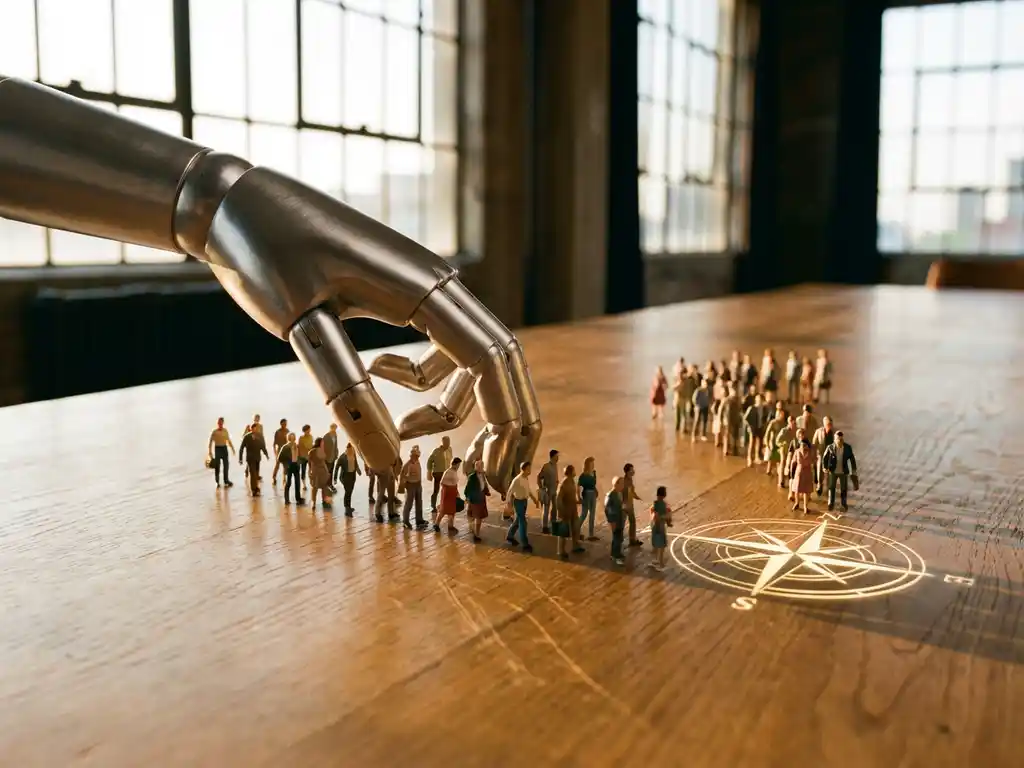
AI supports purpose-driven culture change by providing data-driven insights into employee sentiment, identifying authentic organisational values, and measuring transformation progress across multiple stakeholder groups. It enables conscious businesses to scale personalised leadership development while maintaining genuine human connections throughout the process.
Why AI-powered culture change matters
Traditional culture change initiatives often fail because they lack genuine insight into employee needs and organisational dynamics. AI provides the analytical depth needed to understand complex stakeholder relationships and support authentic purpose discovery.
Rather than relying on surface-level engagement surveys, organisations can use AI to understand how purpose resonates across different levels and departments. The key principle: AI should serve human flourishing, not replace authentic connection.
How AI helps identify and measure purpose
AI uncovers authentic organisational purpose through several approaches:
- Sentiment analysis processes employee communications to reveal themes around meaning, motivation, and values — exposing gaps between stated purpose and lived experience.
- Pattern recognition examines decision-making processes to identify where stakeholder-inclusive thinking already occurs naturally, helping leaders understand existing values rather than imposing external frameworks.
- Predictive analytics distinguish initiatives gaining genuine traction from those creating compliance without real transformation, enabling course correction before resources are wasted.
- Natural language processing analyses internal communications and meeting transcripts to detect shifts in language that signal authentic cultural change.
Tools like the CB Scan can be enhanced with AI capabilities to provide deeper insights into how conscious business principles manifest throughout organisational systems.
Scaling conscious leadership with AI
AI supports conscious leadership development at scale through personalised learning pathways, behavioural analysis, and adaptive coaching systems. Key capabilities include:
- Analysing individual leadership patterns to recommend conscious business practices aligned with each leader’s strengths and development areas.
- Identifying when leaders consider multiple stakeholders versus focusing solely on short-term financial metrics.
- Providing real-time guidance during decision-making to support stakeholder awareness without replacing human judgment.
- Connecting leaders with complementary strengths to build peer learning networks that sustain culture change over time.
Most importantly, AI amplifies conscious leadership rather than replacing it. The technology supports human wisdom and authentic purpose-driven decision-making at the scale needed for lasting organisational transformation.
To begin implementing these AI-powered approaches, consider starting with the CB Scan to establish a baseline understanding of your current conscious business practices.
Related Articles
- What is long-term organizational purpose and why does it matter?
- Is Greenwashing Quietly Destroying Your Brand's Credibility?
- From Generic Mission Statement to Genuine Higher Purpose: How to Make the Leap
- How "Product as a Service" Is Disrupting Traditional Business Models for Good
- What role does middle management play in conscious culture?