
How Mitsubishi Elevator Transformed an Entire Industry by Rethinking Its Business Model

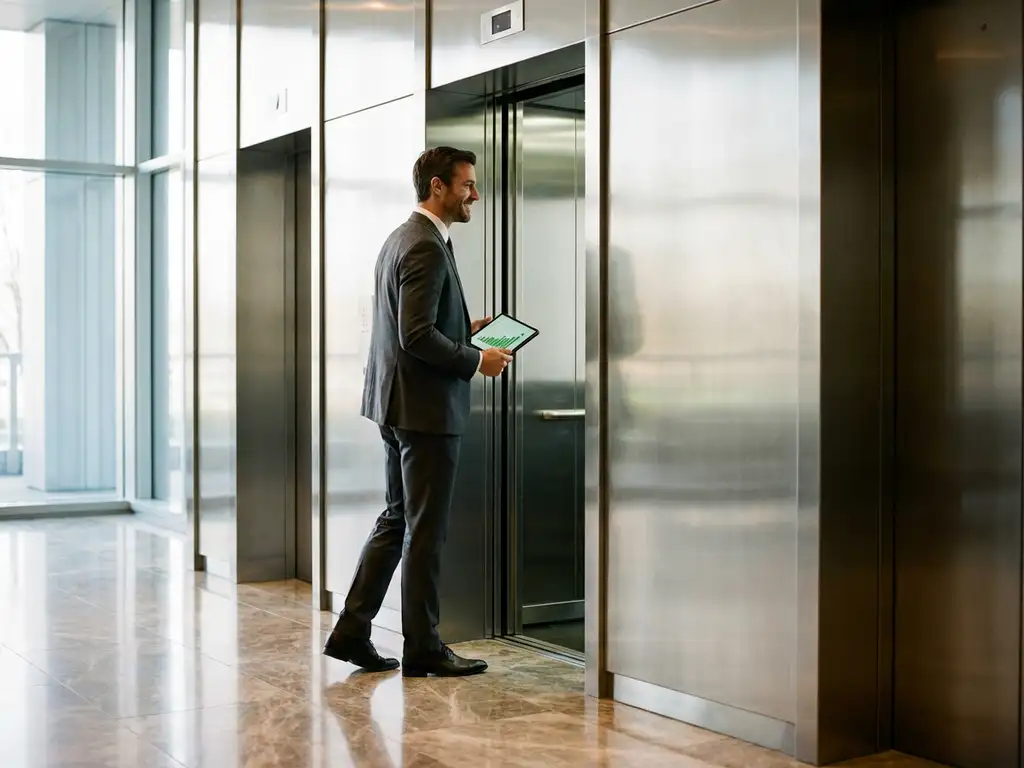
Businessman entering modern steel elevator in office lobby while holding tablet with upward trending business graphs

When Mitsubishi Elevator Europe transformed from a traditional product manufacturer into a comprehensive mobility solutions provider, they didn’t just change their business model—they revolutionised an entire industry. This deliberate transformation shows how companies can achieve sustainable growth while creating value for all stakeholders, not just shareholders.

For Dutch MKB leaders facing pressure to balance profitability with societal impact, Mitsubishi’s journey offers a compelling roadmap. Their shift from selling elevators to selling “elevator movements” exemplifies business model innovation that aligns company success with customer needs, employee engagement, and environmental responsibility.

This transformation showcases the power of a stakeholder-focused strategy and conscious leadership principles that any medium-sized business can adopt. We’ll explore how traditional industry thinking held back progress, examine Mitsubishi’s revolutionary approach, and extract practical insights for your own bedrijfstransformatie journey.

Why Traditional Elevator Companies Failed to Evolve with Changing Market Demands

For decades, the elevator industry operated on a fundamentally flawed premise: selling products rather than solving problems. Traditional manufacturers focused exclusively on unit sales, creating perverse incentives that prioritised quantity over quality and short-term profits over long-term relationships.

This approach created multiple stakeholder conflicts. Customers wanted reliable, long-lasting elevators, but manufacturers benefited from frequent replacements and expensive repairs. Building owners needed minimal downtime, yet service models were reactive rather than preventive. Employees lacked engagement because their work focused on pushing products rather than creating meaningful solutions.

The industry’s narrow, shareholder-centric thinking missed enormous opportunities for service innovation. Stakeholder management was virtually non-existent—suppliers were squeezed for the lowest prices, customers were treated as one-time buyers, and environmental impact was ignored entirely. This zero-sum mentality left everyone except shareholders underserved.

Research shows that such traditional business models typically achieve only 13% employee engagement in Europe, compared to up to 90% in conscious businesses. The elevator industry exemplified this disconnect, with talented engineers and technicians relegated to transactional relationships rather than collaborative partnerships.

How Mitsubishi Elevator Shifted from Product Sales to Stakeholder-centred Solutions

Mitsubishi’s breakthrough came from a simple yet revolutionary question: instead of “How do we sell more elevators?”, they asked, “How do we create the most value for everyone involved in vertical transportation?”

Their answer transformed the entire value proposition. Rather than selling elevator units, Mitsubishi began offering “elevator movements”—a service-based model in which customers pay for reliable vertical transportation rather than owning the equipment. This conscious business transformation aligned everyone’s interests perfectly.

Under this model, Mitsubishi profits by keeping elevators running efficiently for as long as possible. Customers benefit from predictable costs and guaranteed uptime. Employees engage in meaningful problem-solving rather than transactional sales. Suppliers collaborate on long-term innovation rather than competing solely on price.

The environmental benefits proved equally compelling. When companies profit from equipment longevity rather than replacement cycles, they naturally design for durability and efficiency. Mitsubishi’s elevators now last significantly longer, consume less energy, and generate less waste—creating what economists call “decoupling”, where business growth improves rather than harms environmental outcomes.

This stakeholder-focused strategy demonstrates how bewust ondernemen creates competitive advantages. Mitsubishi’s customer retention rates increased dramatically, their innovation pipeline accelerated through collaborative partnerships, and their brand reputation strengthened across all markets.

The Conscious Leadership Principles That Drove Mitsubishi’s Industry Transformation

Behind Mitsubishi’s transformation lay a fundamental shift in leadership consciousness. Traditional elevator company executives operated from what researchers call “downloading”—seeing only familiar patterns and defending existing approaches. Mitsubishi’s leaders practised “generative listening”, remaining open to emerging possibilities.

Their conscious leadership approach embraced three core principles. Transparency became central to all stakeholder relationships, with open communication about challenges, opportunities, and mutual dependencies. Long-term thinking replaced quarterly pressure, enabling investments in relationships and capabilities that traditional models couldn’t justify.

Most importantly, they developed a higher purpose beyond profit maximisation: creating seamless vertical mobility that enhances human potential in urban environments. This purpose provided clear decision-making criteria: does this choice advance our mission while serving all stakeholders fairly?

The leadership team recognised that sustainable growth requires what researchers term “aligned incentives”. When stakeholder success aligns with company success, everyone contributes more creativity, effort, and loyalty. This creates positive feedback loops in which conscious practices become increasingly profitable over time.

Research from Firms of Endearment shows that companies meeting these conscious criteria outperformed the S&P 500 by 14 times over 15 years, particularly during crisis periods. Mitsubishi’s approach exemplifies how conscious leadership creates resilience through stronger stakeholder relationships.

What Dutch MKB Leaders Can Learn from Mitsubishi’s Stakeholder Inclusion Model

Dutch medium-sized businesses can draw powerful lessons from Mitsubishi’s transformation, starting with stakeholder mapping. Begin by identifying all parties affected by your business decisions: employees, customers, suppliers, communities, and the environment. Then ask honestly: how does each group currently experience your company?

The next step is to develop win-win-win solutions that create value for multiple stakeholders simultaneously. Mitsubishi discovered that what customers wanted (reliability), what employees wanted (meaningful work), and what shareholders wanted (sustainable profits) could be achieved through the same service-based model.

For practical implementation, consider conducting a conscious business assessment to understand your current stakeholder relationships and identify opportunities for improvement. Our CB Scan provides a 15-minute evaluation that reveals how consciously your organisation operates within the systemic development model, offering insights for your transformation journey.

The key insight for Dutch MKB leaders is that industry transformation often starts with business model innovation rather than product innovation. Mitsubishi kept making elevators but completely reimagined how value is created and captured. This approach requires less capital investment but more strategic thinking about stakeholder needs and long-term relationships.

Remember that conscious business transformation is a journey, not a destination. Start with one stakeholder group, develop a deeper understanding of its needs, and experiment with solutions that benefit multiple parties. Success breeds success—each positive stakeholder experience builds momentum for broader transformation.

Mitsubishi Elevator’s transformation proves that industry leadership comes not from having the best products, but from creating the most value for all stakeholders. Their conscious business approach generated superior financial returns while advancing environmental sustainability and human flourishing. For Dutch MKB leaders ready to embrace bewust ondernemen, this case study offers both inspiration and practical guidance for your own transformation journey. Ready to assess your organisation’s conscious business readiness? Take our CB Scan to discover your starting point for meaningful transformation.

Related Articles